Grant Management Software
Best Grant Management Software: The 2026 Enterprise Buyer Guide & Evaluation Framework
Published by Fundamentl, the company behind FoundationOS. Editorial policy
The short answer
An objective 2026 evaluation of the leading enterprise grantmaking platforms: FoundationOS Grants, Fluxx, SmartSimple, Submittable, and Foundant GLM.
On this page
The 2026 State of Grant Management Software
The institutional philanthropy technology sector is undergoing its most significant structural shift in twenty years. The era of cumbersome ten-year monolithic contracts with slow legacy providers is giving way to high-speed, API-first platforms that automate workflows, integrate live compliance data, and respect both applicant dignity and reviewer time.
Today, RFP committees evaluate systems not just for database recordkeeping, but as end-to-end orchestration engines connecting intake, reviewer scoring, board docket generation, and automated bank disbursement.
The 7 Core Capabilities of Next-Gen Platforms
When evaluating grantmaking software in 2026, baseline functionality includes:
- Real-Time Non-Profit Tax Verification: Automated API lookup against IRS Business Master Files (BMF) and OFAC sanctions.
- Modular, Autosaving Applicant UX: Eliminating lost submissions and reducing applicant drop-off.
- Flexible Reviewer Workspaces: Blind scoring rubrics, conflict-of-interest detection, and tablet-optimized grading.
- One-Click Board Docket Books: Instant PDF and interactive digital board packets for trustees.
- Integrated Banking & ACH Rails: Direct tokenized bank releases mapped to milestone report approvals.
- Multi-Tenant Cloud Architecture: SOC 2 Type II compliance, continuous zero-downtime updates, and zero manual server patches.
- Two-Way ERP Synchronization: Native ledger sync with NetSuite, Sage Intacct, and QuickBooks Enterprise.
Top 5 Enterprise Grant Platforms Evaluated
Here is an objective assessment of the primary enterprise solutions active in the market today:
1. FoundationOS Grants (Fundamentl) — Best Overall for Modern Foundations
Built specifically for private, community, and corporate foundations, FoundationOS Grants unifies responsive applicant intake, automated IRS 501(c)(3) verification, blind committee scoring, board docket assembly, and automated ACH disbursement rails on a high-speed, modern cloud architecture with unlimited reviewer licensing.
2. Fluxx — Strong for Large Traditional Endowments with Dedicated Admins
Fluxx has a strong legacy footprint among large foundations ($500M+). Its card-based architecture is deeply customizable, though administrators frequently report steep learning curves and heavy consulting costs for workflow changes.
3. SmartSimple — Highly Configurable for Government & University Grants
SmartSimple provides granular configurability for scientific, research, and government grant programs with complex compliance tiers, but its legacy interface and administrative overhead can challenge standard foundation teams.
4. Submittable — Well-Suited for Open-Call Contests & Creative Intakes
Submittable offers an intuitive submission experience popular with literary contests, arts grants, and small municipal relief funds, but lacks the deep endowment accounting, board docket generation, and bank-grade ACH disbursement rails required by large foundations.
5. Foundant GLM — Solid for Smaller Community Foundations
Foundant Grant Lifecycle Manager (GLM) is widely utilized by small-to-midsize community foundations. It offers reliable basic grant tracking and supportive customer service, though it lacks advanced automated banking rails and enterprise API extensibility.
Comprehensive Evaluation Scoring Grid
Evaluation dimensions scored across verified enterprise deployments (Scale 1–10):
| Evaluation Dimension | FoundationOS Grants | Fluxx | SmartSimple | Submittable | Foundant GLM |
|---|---|---|---|---|---|
| Applicant Mobile Experience | 9.8 / 10 | 6.5 / 10 | Submittable: 9.4 | Foundant: 7.2 | SmartSimple: 6.8 | ||
| Reviewer Scoring UX & Blind Rubrics | 9.6 / 10 | 7.8 / 10 | SmartSimple: 8.0 | Submittable: 8.8 | Foundant: 7.0 | ||
| Board Docket Generation | 9.9 / 10 (Instant) | 7.2 / 10 (Manual PDF) | SmartSimple: 7.5 | Submittable: 6.0 | Foundant: 6.8 | ||
| Automated ACH Banking Rails | 9.7 / 10 (Native) | 5.5 / 10 (Third-Party) | SmartSimple: 6.5 | Submittable: 5.0 | Foundant: 6.0 | ||
| Implementation Velocity | 4–6 Weeks | 6–12 Months | SmartSimple: 6–9 Months | Submittable: 3–6 Weeks | ||
| Pricing Predictability | Flat Enterprise Tier | Custom Quote + Seats | Per-seat user licensing models prevail |
How to Run an Efficient 6-Week Software Evaluation
Avoid 12-month RFP paralysis by structuring your evaluation into four focused sprints:
- Week 1–2: Requirements Audit & Scoring Weighting (prioritize applicant drop-off, reviewer efficiency, and payment security).
- Week 3: Vendor Demonstrations (require vendors to demonstrate YOUR specific application and review rubric live, not generic canned decks).
- Week 4: Technical Diligence & Security Review (verify SOC 2 Type II, IRS API integration, and data export guarantees).
- Week 5: Peer Reference Calls (speak with grant managers who migrated from your current system in the past 18 months).
- Week 6: Board Approval & Implementation Contracting.
Questions and answers
A useful next read
How to choose grant management software for your foundationBuild a requirements list, run a realistic demo, and compare evidence before choosing grant management software.
Want to see FoundationOS in action?
See FoundationOS and discuss the workflows your team needs.
Scheduling opens on Calendly in a new tab.
Share this strategic guide with your team & trustees
Pre-formatted for executive discussions, committee reviews, and board presentations.
Keep learning
How to choose grant management software for your foundation
Build a requirements list, run a realistic demo, and compare evidence before choosing grant management software.
How to compare grant management software costs
Build a comparable cost model using written quotes, implementation scope, usage assumptions, and exit terms.
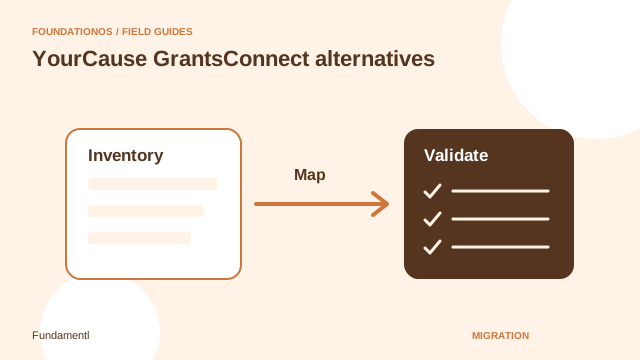
Best YourCause GrantsConnect Alternatives: Enterprise Comparison & Migration Blueprint
Compare modern alternatives to Blackbaud YourCause GrantsConnect. Detailed evaluation of UX, automation, total cost of ownership, and a proven 60-day migration guide.