Grant Operations & Workflows
The Grant Lifecycle Explained
Published by Fundamentl, the company behind FoundationOS. Editorial policy
The short answer
A field guide to the grant lifecycle from program design and application review through award administration, reporting, and closeout.
On this page
Overview
A grant lifecycle is the chain of decisions and obligations that begins before an application opens and continues after the final payment. The useful unit is not the form; it is the complete record connecting program intent, applicant evidence, reviewer judgment, award terms, payments, reports, and closeout.
Grants.gov organizes the federal lifecycle into pre-award, award, and post-award phases. Private and corporate grantmakers use different terminology, but the same control problem remains: every handoff must preserve who decided what, why they decided it, and what must happen next.
The lifecycle in seven operating stages
A practical operating model expands the three broad phases into seven stages that staff can own and measure. Each stage needs an entry condition, an accountable owner, required evidence, and an exit decision.
Program design: define purpose, population, geography, eligibility, budget, timeline, and decision authority.
Application: collect only the information needed to test eligibility and make the stated decision.
Screening: document completeness, eligibility, conflicts, and any due-diligence exceptions.
Review and decision: preserve scores, narrative judgment, recommendation, recusals, conditions, and final authority.
Award setup: convert the decision into an agreement, approved amount, payment schedule, requirements, and contacts.
Active monitoring: track deliverables, reports, changes, risks, payments, and communication in the award record.
Closeout and learning: resolve balances and requirements, record outcomes, and carry lessons into the next cycle.
Treat the application as the beginning of the decision record
The most expensive failure occurs when the approved application is copied into a new award tracker. Conditions get shortened, the approved budget becomes an attachment, and later staff cannot tell whether a payment reflects the board decision. A durable system promotes the same record from application to award instead of recreating it.
At minimum, preserve the original request, recommended and approved amounts, decision date, decision maker, conditions, relevant reviewer rationale, agreement version, payment schedule, and reporting plan.
Match controls to the stage—not to a generic checklist
Controls should answer a specific risk. Eligibility checks prevent ineligible work from reaching review. Conflict attestations protect the decision. Payment-readiness checks prevent funds from moving before required documents or reports are complete. Closeout checks prevent unresolved balances and obligations from disappearing.
Worked example: a conditional $50,000 award
Suppose an applicant requests $50,000. Staff recommend $42,500, and the board approves that amount in two payments, with the second payment contingent on a mid-year narrative and revised insurance certificate. The award workspace should inherit the $42,500 decision, create both payments, attach the two blockers to Payment 2, and retain the difference between the request and approval.
If the mid-year report arrives late, the system should show a late requirement and a blocked payment—not silently change the award status to “on track.” That distinction is what makes the record useful during audits, board questions, and staff transitions.
Measure handoffs, not just totals
Portfolio totals describe scale. Operating metrics reveal friction. Track time from submission to screening, screening to decision, decision to agreement, and report acceptance to payment release. Also track applications returned for missing information, decisions with unresolved conditions, overdue requirements, and payments blocked by incomplete evidence.
A 30-day implementation sequence
Start with one live or recently completed cycle. Map its real stages and exceptions, define the minimum evidence at each handoff, configure permissions, migrate active records, and rehearse one application through closeout. Historical data can follow after the current workflow produces a trustworthy record.
Questions and answers
Sources and further reading
- The Grant Lifecycle — Grants.gov
Defines the pre-award, award, and post-award phases used as the baseline lifecycle in this guide.
- Pre-Award Phase — Grants.gov
Outlines opportunity announcements, application screening, programmatic review, conflict safeguards, and financial review.
- Reports from grantees — Internal Revenue Service
Describes report content and follow-up expectations when expenditure responsibility applies.
A useful next read
Post-award grant management: what to track after approvalSet up an award record that connects conditions, reports, payment readiness, grantee communication, and closeout.
Want to see FoundationOS in action?
Bring questions about applications, reviews, awards, and reporting to a FoundationOS product demo.
Scheduling opens on Calendly in a new tab.
Share this strategic guide with your team & trustees
Pre-formatted for executive discussions, committee reviews, and board presentations.
Keep learning
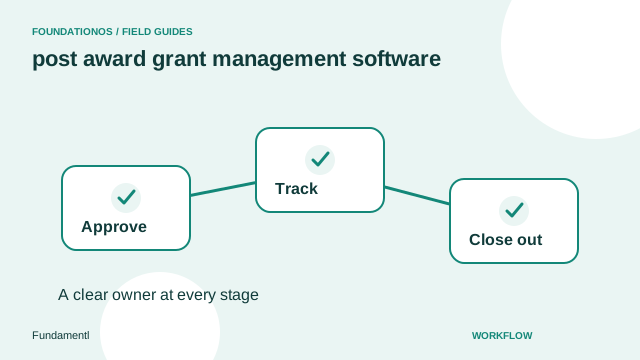
Post-award grant management: what to track after approval
Set up an award record that connects conditions, reports, payment readiness, grantee communication, and closeout.
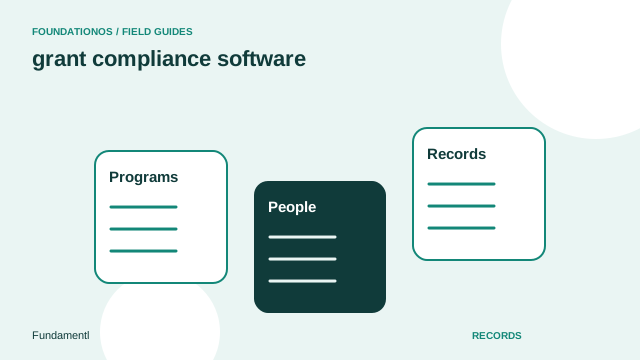
Grant Compliance Management: Build a Reliable System
A control-based guide to grant compliance management, covering obligations, evidence, monitoring, exceptions, and corrective action.