Grant Management Software
Grant Management Software: A Practical Buyer’s Guide
Published by Fundamentl, the company behind FoundationOS. Editorial policy
The short answer
An evidence-based buyer’s guide to grant management software, including requirements, demo tests, data migration, controls, reporting, and total cost.
On this page
Overview
Grant management software should make decisions and obligations easier to verify. A polished application form matters, but the harder test is whether staff can trace an award back to the application, review, approval, agreement, payment conditions, and reports without reconstructing the story from email.
This buyer’s guide focuses on observable tests. Instead of comparing feature checklists, bring one real cycle and ask each vendor to complete the same work from intake through a blocked payment and closeout.
Write requirements as decisions your team must make
“Configurable workflows” is too vague to evaluate. Write requirements as scenarios: a reviewer must recuse without seeing peer notes; a board member must see the recommendation without private staff discussion; finance must know why a payment is blocked; an administrator must reconstruct who changed an approved amount.
Name the user and decision.
Name the evidence required.
Name the action or approval.
Name what must be recorded for later review.
Use one scripted demo across every vendor
Give vendors a sample program, two applications, a conflicted reviewer, a conditional award, a revised report, and a payment blocker. Ask them to configure and demonstrate it live. This exposes where the product depends on custom services, spreadsheets, or manual workarounds.
Create eligibility and application rules.
Assign reviewers and record a recusal.
Prepare a board-ready decision view.
Approve a different amount than requested.
Block a payment until a report is accepted.
Export a complete decision and activity history.
Inspect the data model before the dashboard
Dashboards can conceal disconnected records. Confirm that organizations, contacts, programs, applications, reviews, decisions, awards, payments, requirements, reports, documents, and activity are related records with stable identifiers. Ask whether an export preserves those relationships or produces unrelated spreadsheets.
Test permissions with realistic conflicts
Role labels are not enough. Test field-level and record-level access, temporary reviewers, recusals, applicant-visible versus internal statuses, and what former staff can access. Review logs should show material changes without exposing confidential content to the wrong audience.
Price the implementation, not only the subscription
Total cost includes workflow design, data cleanup, migration, integrations, configuration, training, support, reporting work, and future changes. Ask which work requires the vendor, which work admins can perform, and how pricing changes with users, applications, programs, storage, or payments.
A practical selection scorecard
Weight the evaluation around outcomes rather than feature count. A useful starting point is 25% workflow fit, 20% data integrity and exportability, 15% permissions and auditability, 15% reporting, 10% applicant and reviewer experience, 10% implementation and support, and 5% price predictability. Adjust the weights before demos begin.
Red flags to resolve before signing
Pause when a vendor cannot demonstrate an end-to-end scenario, treats post-award work as attachments, requires support tickets for routine configuration, cannot export activity history, or describes security and permissions only at a high level. Record every promised workaround and service dependency in the agreement.
Questions and answers
Sources and further reading
- The Grant Lifecycle — Grants.gov
Defines the pre-award, award, and post-award phases used as the baseline lifecycle in this guide.
- Grants Management — Grants.gov
Summarizes the policy, administration, oversight, training, and stakeholder work performed across the award lifecycle.
- Grants by private foundations: Expenditure responsibility — Internal Revenue Service
Explains the procedures certain private foundations must use to oversee grant purpose, grantee reports, and IRS reporting.
A useful next read
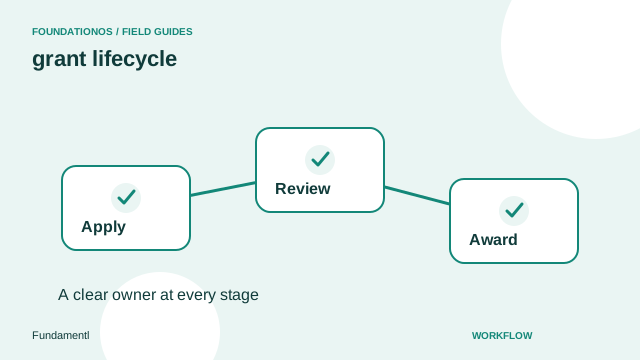
The Grant Lifecycle ExplainedA field guide to the grant lifecycle from program design and application review through award administration, reporting, and closeout.
Want to see FoundationOS in action?
Bring questions about applications, reviews, awards, and reporting to a FoundationOS product demo.
Scheduling opens on Calendly in a new tab.
Share this strategic guide with your team & trustees
Pre-formatted for executive discussions, committee reviews, and board presentations.
Keep learning
The Grant Lifecycle Explained
A field guide to the grant lifecycle from program design and application review through award administration, reporting, and closeout.