Competitor Alternatives & Comparisons
How to plan a migration from YourCause or another grant system
Published by Fundamentl, the company behind FoundationOS. Editorial policy
The short answer
Inventory your records and relationships, confirm what you can export, map them to the new system, and test a representative sample before choosing a cutover date. Agree on acceptance checks, exception ownership, and a fallback plan before the old system becomes unavailable.
- Confirm export access and contract terms early.
- Test relationships and attachments, not just row counts.
- Choose a cutover date only after required checks pass.
On this page
Worked example · illustrative
Example: an organization has two source records
Illustrative scenario: two records share an identifier but have different contacts and grant histories. The migration team flags the match, retains both source IDs, and asks the record owner to resolve it. A name match alone does not justify combining grants or discarding attachments.
1. Inventory what needs to move
List organizations, contacts, applications, reviews, decisions, awards, payment references, reports, attachments, and activity history. Record the owner, export method, and required retention approach for each. Confirm what the source system and your contract actually permit.
2. Map IDs and relationships
Define how source IDs will be retained and linked to destination IDs. Decide how to handle duplicates, archived organizations, amended awards, and multiple contacts. Keep an exception log rather than silently dropping records.
3. Test a representative sample
Include a completed award, an active award, a conditional approval, a multi-installment payment schedule, a returned report, and attached files. Verify associations and permissions as well as values.
Check record counts and relevant totals.
Open migrated files and verify they belong to the correct record.
Confirm that reviewers and grantees see only appropriate records.
Resolve or explicitly accept each exception before cutover.
4. Plan a recoverable cutover
Choose whether to freeze changes or import changes since the test. Agree on the source of truth during transition, staff training, acceptance evidence, and a go/no-go decision owner. A timeline depends on scope, data quality, access, integrations, and team availability; this guide is not a delivery commitment.
Put it into practice
Migration readiness checklist
Use this template with program, operations, IT, and finance colleagues to record ownership, evidence, and cutover decisions.
0 of 6 checked
Checks are temporary for this visit. Use the editable template to keep your notes.
Preview the editable template
# Grant-system migration readiness checklist

Source system: ____
Destination system: ____
Migration owner: ____
Decision owners: ____

## Dataset record (repeat per dataset)
Dataset / entity: ____
Source owner: ____
Export format and access window: ____
Source ID: ____
Destination ID / matching rule: ____
Relationships and attachment handling: ____
Permission mapping: ____
Expected count / amount: ____
Observed count / amount: ____
Exceptions and owner: ____

## Cutover
Open-cycle handling: ____
Change freeze or delta import: ____
Acceptance criteria and evidence: ____
Fallback trigger and owner: ____
Legacy read-only access / retention decision: ____
Staff communications and training: ____
Go / no-go decision and authorizer: ____
A useful next read
How to choose grant management software for your foundationBuild a requirements list, run a realistic demo, and compare evidence before choosing grant management software.
Want to see FoundationOS in action?
Use a product demo to discuss your current workflow and migration questions. Timing and scope depend on your requirements.
Scheduling opens on Calendly in a new tab.
Share this strategic guide with your team & trustees
Pre-formatted for executive discussions, committee reviews, and board presentations.
Keep learning
How to choose grant management software for your foundation
Build a requirements list, run a realistic demo, and compare evidence before choosing grant management software.
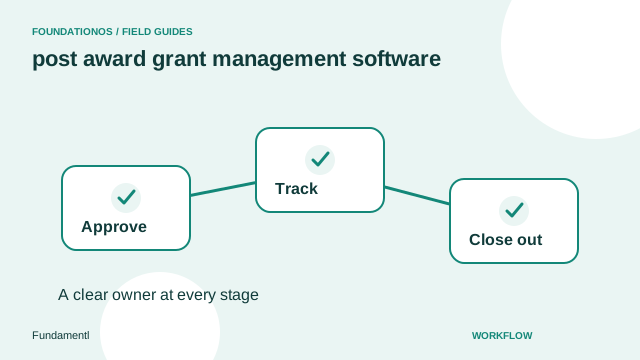
Post-award grant management: what to track after approval
Set up an award record that connects conditions, reports, payment readiness, grantee communication, and closeout.
How to compare grant management software costs
Build a comparable cost model using written quotes, implementation scope, usage assumptions, and exit terms.